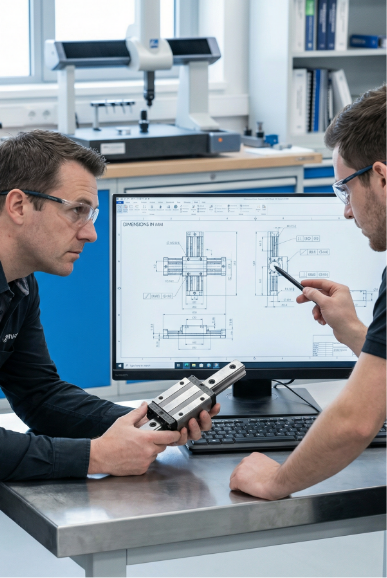


HIGH PRECISION
In linear motion systems, high precision means maintaining micron-level geometric accuracy, stable friction behaviour and a predictable dynamic response across the full stroke and throughout the service life of the machine.

Geometric Accuracy
Triple-ground raceways with tolerances controlled to ±0.010mm

Friction Stability
Stable breakaway force and consistent motion profiles

Vibration Control
Running deflections down to 0.009 μm (9 nm)
The factors that typically compromise this are well known: variation in rail geometry, uncontrolled preload, rolling element skew and irregularities in the raceway.
In practice, those problems show up as alignment drift, inconsistent breakaway force, micro-vibration, longer settling times and poor repeatability. You see it most clearly in fine positioning or metrology work, where small mechanical errors quickly become measurement errors.
IKO linear guides address much of this at component level. The raceways are triple-ground, parallelism is controlled to micron-level tolerances, preload classes are defined, and the roller retention system stabilises the rolling elements.
The result is that the guide itself becomes a stable geometric reference with predictable friction characteristics and consistent stiffness. When those fundamentals are under control, the rest of the system behaves more predictably – which is exactly what you want in high-precision positioning or measurement applications.
Geometric Accuracy
Geometric Accuracy and Dimensional Stability
High precision systems require micron-level straightness, controlled rail height and stable geometries across the full stroke. Variability at component level introduces the risk of alignment drift, uneven load distribution and unnecessary geometric error.
HOW IKO ADDRESSES THIS
- Triple-ground raceways that remove localised high spots and improve straightness along the entire rail length
- Precision class tolerances, with overall assembly height controlled down to ±0.010mm (Super Precision)
- No reliance on selective matching (matched pairs) — manufacturing processes maintain these tolerances and allow greater interchangeability between components
- Localised induction hardening (58–64 HRC) to maintain long-term dimensional stability under cyclic load
OUTCOME
A guideway that can be treated as a defined mechanical reference within the machine structure. Geometric consistency reduces assembly correction, improves axis alignment and supports predictable system-level accuracy.
Friction Stability
FRICTION STABILITY AND MICRO-MOVEMENT CONTROL
In fine positioning applications – scanning, probing or optical alignment – friction instability is often the limiting factor. Stiction, micro-stick, variable breakaway force, and rolling element skew introduce positioning error, particularly at low speed or during very small incremental movements.
HOW IKO ADDRESSES THIS
- Controlled preload options, from zero clearance through to defined preload levels
- MX roller retention systems that minimise skew and differential slip
- Precision-ground raceways that stabilise rolling contact conditions
- Non-recirculating crossed-roller or ball type designs available where ultra-smooth motion is required
- Consistent friction characteristics across the full stroke length, supporting class-leading repeatability
OUTCOME
Stable friction behaviour improves controllability at both low and high speeds and improves repeatability. In practice, that reduces reliance on software compensation or aggressive servo tuning. Motion profiles remain predictable under real operating conditions.
Vibration
VIBRATION AND DYNAMIC PREDICTABILITY
Micro-vibration generated within the guideway increases settling time and reduces measurement stability. In high-speed inspection or positioning systems, that directly limits throughput and achievable precision.
HOW IKO ADDRESSES THIS
- Triple-pass grinding, which eliminates the microscopic waviness
- Uniform preload control, ensuring consistent stiffness along the stroke
- Crossed-roller designs that provide high rigidity within compact envelopes
- Reduced roller skew, lowering vibration transmission into the machine structure
- Stable contact geometry that supports predictable dynamic modelling
OUTCOME
Improved raceway uniformity and controlled stiffness reduce oscillation after movement and shorten settling time. Comparable performance can be achieved with running deflections down to 0.009 µm (9 nm).
Conclusion
Our engineers’ take
High precision ultimately comes down to control – control of geometry, contact conditions and stiffness.
IKO’s manufacturing discipline, tolerance management and rolling element design provide the mechanical stability required for sub-micron-level systems used in metrology, semiconductor, medical and precision automation applications.